
By Vilner Rasmussen
For a long time, the Danish word gevinstrealisering — benefits realisation — was the headline of everything I did. It was on my website, in my proposals and in the first sentence of most meetings. Clients nodded. Steering groups put it on their agendas. And far too often, the benefits still didn’t arrive.
It took me years to say the uncomfortable part out loud: the benefit was never the thing to manage. It is the result of something else — and if you manage the result instead of the thing that produces it, you end up reporting on hope.
Benefits Come Last, Not First
Value moves through a chain. Change enablers — a new system, an updated process, a dashboard, a training programme — create possibility. Changed behaviour is what actually happens when people work differently: faster decisions, fewer errors, less firefighting. Only then is there a benefit to document.
Most benefits work starts at the end of that chain. A benefit is promised in the business case, a target is set, and a year later someone is asked to prove it. By then nobody can say which link broke — whether the enabler was never adopted, or the behaviour never changed, or the benefit was simply counted twice.
The Capability Is the Thing to Manage
What carries an organisation from strategy to result is a capability: an ability the organisation builds and holds, made of three components working together — Platforms & Tools, Business Processes, and People & Competencies. That is something you can actually look at, steer and keep. So that is where the method now starts.
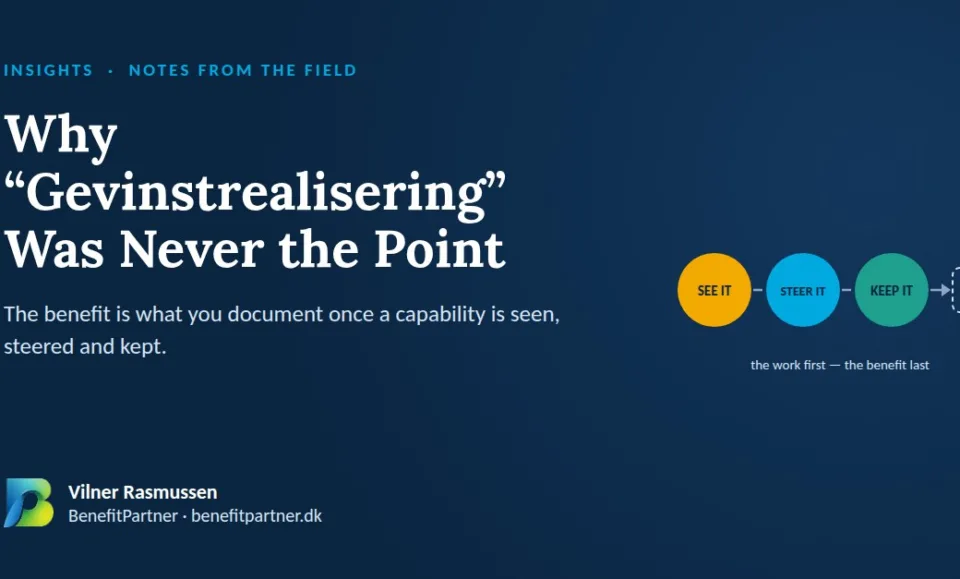
- SEE IT — baseline the capability as it actually stands, measured on your own records rather than asked about in a workshop.
- STEER IT — close the gap with an owned plan, including where automation and AI genuinely remove manual work.
- KEEP IT — make the knowledge something the unit holds, tested and certified, not something three people happen to carry.
When a capability is seen, steered and kept, the benefit stops being a promise. It becomes a measurement you can take.
What Changed in the Business Case
The business case follows the same three words. A plan is written before the decision, line by line, each with a source, a certainty and a named owner. Every month the team adds what the data now shows — without overwriting the original plan. And the harvest is checked against that plan, at the same point in the ramp, by the Benefit Owner. Never by us.
That last point matters more than it looks. A consultant who reports their own result has every reason to find it. A Benefit Owner who signs the harvest has every reason to check it.
So Is Gevinstrealisering Dead?
No. It just moved. It is no longer the headline — it is the evidence at the end. The work is the capability. The benefit is what you are allowed to write down once the work has held.
If you have a business case on the table right now, try one question: for each benefit line, which capability produces it, and who will sign that it landed? If the answer is unclear, the benefit is still a hope.
Related: Business Case · The Benefit Team · The free Business Case Builder
